What Food Reminds You of Home? Alie Yuldasheva from The Pickle Project on Vimeo.
Thanks to Alie for making that sharing idea a reality, Anna Harty for editing, and Barb Weiser for hosting us on the Simferopol leg of our trip last summer. And a special note to Peace Corps volunteers: we met, as you'll hear, Alie through Peace Corps volunteers--so other volunteers, please join in. We'd love to see other favorite food videos--a great student project for English teachers!
Wednesday, April 4, 2012
Our Debut Video! What Food Reminds You of Home?
Last summer, on a visit to Simferopol, Alie Yuldasheva was generous enough to sit down with us in a Crimean Tatar restaurant and talk about her own family traditions. We're far from video experts, but this was the start of some short video podcasts that we'll be sharing with you. The Crimea provided us with so many memorable experiences and we were
privileged to learn more about the diverse cultures there. Alie's favorite food is a great metaphor for our Pickle Project work. Plov, she says, "represents [the[ sharing idea."

Saturday, March 31, 2012
Greek Life

Maripoul Oblast is home to largest Greek-Ukrainian population in the country. Lubov, an ethnographer at the Donetsk Regional Museum, explained that there has long been a strong Greek influence in the Mariupol region, as Greek sailors and traders made their way from the Sea of Azoz, across the southern steppes. Greek settlements in the region were expanded in the 1780’s as Katherine the Great sought to consolidate her rule in the Black Sea region, especially Crimea. At the time, Greeks were the primary labor force in Crimea, Lubov explained. In an effort to weaken rising powers of the Crimean Khanate on the Peninsula, Katherine’s forces pushed the Greek population, along with large groups of Crimean Tatars, into the territories of Mariupol. This was one component of Katherine’s larger “planned colonization” strategy undertaken across Ukraine.
Greek villages are scattered across the region but Saratana and Starry Krim (Old Crimea) are two of the most prominent. Greek cultural traditions and practices, including food preparation, remain strong in the region. We also learned that there are efforts underway to preserve the Greek language spoken in the villages of Mariupol, a dialect called Rumaiica.
We had the distinct pleasure of sitting down with Tatiana Bohadetsa, director of the Museum of Greek History and Ethnography in Sartana to sample some Greek-Ukrainian specialties. To our great indulgence, Tatiana is not only an expert of local Greek history and culture, she is also the author of a cookbook featuring Greek specialties of the region.
 Included in this feast were the delightfully named smoosh (шмуш), puffy pastries filled with spiced meats or fish and potatoes. My favorite were crispy fried triangles stuffed with pumpkin and sauteed onions.
 For Tatiana, these dishes are central to helping keep the connection to her Greek heritage alive. She also noted that food is an easy access point for people. It tastes good, helps them remember and helps them learn. We couldn’t agree more.
Top to bottom:
Mural at the museum in Saratana
Cookbook
Smoosh
Thursday, March 22, 2012
KGB Pickles

Kim McCray, returned Peace Corps volunteer, ends her food trilogy with a pickle memory. Thanks Kim, for sharing, and Peace Corps volunteers, we'd love to hear from more of you!
This
is the Pickle Project, so it is only fitting that I end this list with a pickle
memory.
Toward
the end of my service I agreed to participate in “Adopt-A-Cluster”, a practice
developed by Peace Corps to encouraged seasoned, veteran volunteers to visit
the brand-new trainee groups, (clusters), at their training sites. Because the trainees had been
interacting almost exclusively with Peace Corps staff and host-country
nationals up to this point, getting the opportunity to pick the brains of
current volunteers and get feel for the practicalities of Peace Corps life
beyond the technicalities of training was invaluable.
So,
with fond memories of the volunteer who had adopted my cluster two years
before, I agreed to help with the project and boarded a train to Kyiv and then
caught a bus and headed north to the city of Chernihiv. A Ukrainian Peace Corps staff member
met me at the bus stop on an especially cold and dark night and explained to me
the plans for the next day as we walked quickly down a bumpy unlit sidewalk and
then weaved our way through a maze of Soviet high-rise apartment
buildings. Soon enough we arrived
at our destination and rang the buzzer.
A young woman answered the door, and pattering up behind her came an
elderly woman. We were introduced – her name was Luibov – and I learned that
Luibov would be hosting me for the next two nights. The Peace Corps staff member then gave me a piece of paper
with directions to where I was supposed to go the next morning, and left. Luibov was cheerful and I was very
pleased to find that she spoke only Russian (I had been trained and continued
to study Russian, but often heard Ukrainian or the Russian-Ukrainian blend “Surjik”
at my site, so communicating with someone who only used Russian was always a
relief). It was late however, so
we did not talk much; she showed me to the living room where I was to sleep on
the couch, and said goodnight.

The
next morning I found a typical Ukrainian breakfast spread for me on the table –
buttered bread, slices of cheese and sausage, peach juice, and a bowl of
pickles. Ten minutes later, I had
eaten three large dill pickles and packed two more for my lunch. They were very
simply the best pickles I have ever had in my life. Perfectly crunchy and tart but with a sweetness I’d never
tasted before or since. That night
I cleaned the bowl once again and asked for the recipe. In typical Ukrainian fashion, Luibov
didn’t write it down but instead tried to explain the process verbally. I knew I was in trouble when early on
in her explanation she said “…then I add that brown seed…I don’t remember what
it’s called…”
Several minutes later she finished giving me her “recipe”, and while I had a
vague notion of what she had done, I definitely had not grasped enough details
to duplicate her process. Now,
more than three years later, I remember nothing about that recipe except the
brown mystery seed.
The
next morning, as I was packing my bag to leave, Luibov approached me with a
photo in a frame and a box and told me to sit down. I was worried that if I didn’t leave soon I might miss my
train, but I agreed to stay a few more minutes. We sat down and Luibov opened the box. Inside were medals,
newspaper clippings, coins, and various other knick-knacks. She asked me if I knew what they were
and I guessed army memorabilia, as medals from the Great Patriotic War (WWII)
are commonplace souvenirs in Ukraine.
She smiled and shook her head and then showed me the photo. “That is me,
and that is my husband” she said. The picture was of a couple standing on a
stage in some sort of official ceremony. “We were in the KGB, the both of us,
for almost thirty years. This is us receiving an award for our excellent
service.”
Now
of course, having lived in a former Soviet country for more than two years, I
am sure that this was not my first interaction with someone who had been
affiliated with the KGB, but this was the first time I’d been made aware of
it. The shock factor hit me as I
realized that I had spent two nights under the roof of a 30 year KGB
veteran. Luibov then went on to
joke that in all those 30 years she had never actually met an American until
now. “Look at these things
Kim!” she exclaimed as she pawed through the box, “I cannot believe you are
here in my home!” I shook my head in disbelief as well and we continued to
laugh about it as I grabbed my bag and walked down the hall towards the front
door. I thanked her for her
hospitality and headed out. I hadn’t made it more than a few steps when she
called to me and scurried after me, holding out plastic baggy. I opened it –
inside was a jar of pickles. Delicious KGB pickles.
Top: Kim and Luibov
Bottom: Pyotre Petrovich Konchalovsky (b.Ukraine, 1876-1956) Still Life with Teapot and Breakfast. 1946
Saturday, March 17, 2012
Blue Beauty

I have long wished to write a post about poppy seeds because they are fabulously under appreciated and prominently featured in a good many Ukrainian dishes. And, what do you know, thumbing through newly arrived April issue of the American food magazine Saveur, I found a charming article about these blue-black beauties. I felt scooped, of course, but it rekindled my interest in proffering poppy observations.
The perfumey tasting seed of the flowering plant Papver somniferum, poppy seeds (mak) are tiny and actually kidney shaped. They also have high fat content and are a rich source of calcium and manganese. I learned from Gabriella Gershenson’s Saveur article that poppy seeds are ancient and have been cultivated since the Neolithic era in Europe (around 1,000 years BCE). White poppy seeds are common in Asian cuisines and played a fascinating role in the British colonization of Bengali India. The indigo hued variety is more common in western, European dishes.
Often paired with honey, poppy seeds are widely used in Ukrainian fare. Poppy-laced cakes, doughnuts and swirly rolls are everyday treats. According to Culinaria, edited by Marion Trutter, Nicolai Gogol was rather fond of honeyed poppy seed cake, apparently calling it a “paradisaical dish.” Poppy seeds are also stuffed into a sweet vareneky (Ukrainian dumpling) or serve as the base for sweet sauces. Poppy is also the star of kutya (кутя), one of 12 traditional dishes served at Christmas time. Kutia is a kind of wheat porridge, lavender with poppy and sweetened with honey, that is topped with chopped walnuts and dried fruits. The dishes sweetness, I am told, mirrors the sweetness of Christ. And, boy is sweet!
 Of course, poppies are also the source of that ancient, Lethean substance opium, which is made from the air drying of the milky, white latex of unripe poppy seed pods. I have heard rumors about poppy cultivation being illegal in Ukraine. A friend even told me a story about a babushka in village in L’viv Oblast that was arrested for nurturing poppies in her kitchen garden. (Pray tell, dear Pickle Project readers, if you know about the legality of poppy cultivation in Ukraine). (Incidentally, through my meticulous web research, I also learned that, indeed, eating large quantities of poppy seeds will contribute to a false positive in drug testing, as was confirmed on an episode of the show MythBusters.)
For more interesting poppy reading, check out Gabriella Gershenson’s Saveur article Flower Power, a range of articles about the interesting poppy research happening at the University of Calgary and tips on poppy seed cultivation at the Washington State University.
Wednesday, March 14, 2012
Baba Valya's Green Borsch

Everyone knows about borsch. In fact, I would place a pretty high wager on the fact that if the average American was asked to give a examples of Ukrainian/Russian cuisine, almost all would say borsch and vodka. However, while the red beet borsch that most Americans know so well is the only borsch variety to have made the jump across the pond to find popularity in the U.S., it is not the only type of borsch that Ukrainians enjoy. Now, I love red borsch just as much as the next gal, but if given a choice between red borsch and it’s green counterpart, I will choose the latter almost every time - partly because I prefer the taste, but partly because it is green borsch that reminds me of Valya.
Valya was my next-door neighbor in my village of Priyutivka, and in our small apartment building of eight flats, she was the person I came to know best. To a certain extent our living arrangements made such a relationship almost unavoidable, at least that is how it seemed at first, as I became aware that my every move was being watched by my neighbors, with Valya, who I eventually came to refer to as my “Ukrainian grandmother”, taking the lead in this hobby of “American-watching”. At first it made me uncomfortable. But as time progressed I came to value their watchful eyes, as I knew very well that anytime someone rang my doorbell, Valya was peeping out the eye-hole from her caddy-corner apartment to make sure that everything was all right. If it was a friend or coworker or someone else I obviously knew, I never heard a peep from her. But the few times when I opened my door to a stranger (usually someone from the utility company or someone lost and knocking on the wrong door), Valya was there in a jiffy, coming to my aid and translating when necessary. I came to count on her as my own home security system.

Bag inspections, as I have since dubbed them, were fairly commonplace throughout my Peace Corps service, but especially at the beginning. Several times in my first month in the apartment, Valya would intercept me on my way home from the village shop. She would then open my bag and paw around, announcing to the other babusyas on the bench the sorry evidence of my helplessness that she saw inside. “Oh no, don’t buy the canned mackerel in that oil, you must buy it in water…” or “Kimusia, why are you paying such prices for carrots? Go into the city where they’re cheaper”, or worst of all, “Slava Bogu (My God), this pelmeny is storebought trash!”
After failing several of such bag inspections, it became apparent to Valya that I did not know how to shop OR cook, and so she took me under her wing. For the next year and a half, at least once or twice a week my doorbell would ring and I would open it to find Valya standing there in her slippers holding out a mason jar full of cherry compote or an old tea towel wrapped around a half loaf of bread. But of all the food that Valya gave me, it was green borsch that became the emblem of our relationship. I still remember the first time I tasted it. My doorbell rang and Valya handed me a bowl of a green broth soup with half of a hard-boiled egg floating in the center. I asked what it was. “Zelyony Borsh” she replied. Well, green borsch I had never seen, so I tried it on the spot and couldn’t believe how savory yet refreshing it was. I praised her and asked for the recipe and hurried inside to finish the bowl. A couple of minutes later the doorbell rang again, and instead of coming back with the recipe, Valya had returned to my door to give me the rest of the pot of soup!
As the summer waned and sorrel, a key ingredient vanished, Valya stopped making me “summer borsch” for a time, but the next spring it was back in her repertoire. I think I can safely say that Valya brought me green borsch at least 15 or 20 times, and each time it hit the spot. Sometimes I’d eat it hot, sometimes cold, but always with a dollop of sour cream and a slice of black bread.
Before I left Ukraine I did manage to get Valya’s recipe, and have included it below. In the typical fashion of any cook who has made a dish countless times, Valya did not write down any ingredient amounts, but I have added the amounts that I have used when making this dish.
Valya’s Green Borsch
Ingredients:
100 grams of pork
3-4 big potatoes
2 hard-boiled eggs, sliced
sorrel (2 cups fresh)
salt
sour cream
dill (optional)
3-4 big potatoes
2 hard-boiled eggs, sliced
sorrel (2 cups fresh)
salt
sour cream
dill (optional)
Preparation:
Fill a pot with water and put it on the fire
to boil. Cut the meat into medium pieces. Put the meat into boiling water. Take
off the skin of potatoes. Chop the potatoes in medium pieces. Let the meat cook
for about 4 or 5 minutes and then add the potatoes and sorrel and the egg
slices. Boil everything 10-15 minutes more. Add salt to taste and add sour
cream on top.
Friday, February 24, 2012
I Can Almost Taste Them: Food Memories of a Peace Corps Volunteer

We're pleased to welcome another guest blogger. Kim McCray was a Peace Corps volunteer in Ukraine several years ago and is now This is the first of three posts about those food memories that stand still stand out, several years on. Kim is from Staunton, Virginia and currently lives in Raleigh, NC where she is completing a dual-degree between North Carolina State
University's History Department (MA in Public History) and The
University of North Carolina at Chapel Hill's Library and Information
Science School (MS in Library Science). Come May, she'll graduate and be seeking work as an archivist. And of course, if you've a food memory to share of Ukraine (or Belarus, or Georgia, or Moldova, or...) we'd love to hear it!
Ask any returned Peace Corps
Ukraine volunteer to make a list of the most vivid memories of their time in Ukraine,
and somewhere in the top five recollections, probably sandwiched between
“crowded marshrutka rides” and “bundled up starfish babies” will be a mention
of a Ukrainian dish – of where they were when they first tasted it, of who
prepared it for them, and what was going on in their life at the time. This only makes sense, as just as
Ukrainians take great pride in their traditional dishes, we Peace Corps
volunteers take great joy in eating them!
In the middle of winter, when it gets dark by 4:30, the temperature dips
to zero and without internet or television a book seems your only companion,
there is little that can warm the heart of a Peace Corps volunteer quite as
much as a neighborly invitation to come enjoy a hot cup of tea and a slice of
tort. And in the hottest days of
summer, when school is in recess and traveling from summer camp to summer camp
and hosting visiting friends and family from the States starts to wear thin,
nothing can beat escaping from a stiflingly hot bus at the end of a long
journey to find a kind babusya waiting to sell you a bucket of the most juicy
and sweet strawberries you have ever eaten for the high price of about 50
cents.
Now, more than three years
removed from my Peace Corps service in the village of Priyutivka (Oleksandriya
Region, Kirovograd Oblast), these memories are every bit as rich as they were
during my service. Three
particular food memories stand out above those already stated and trigger
memories so rich that “I can almost taste them.”
1. THE FIRST SUPPER
As I am sure is true for most former Peace Corps volunteers, my memories of the day I first met my host-family are a bit fuzzy. It seems that my brain spent so much energy feeding the anxiety and anticipation of the day that it was not able to properly store the memories as it did later Peace Corps events. The snippets I do remember well are scattered - I remember looking out the window and watching other volunteers pour off the bus when it reached their site. I remember having difficulty shutting my suitcase in the back of the rickety Lada car that carried me to my house. I sort of remember sitting on the sofa and sharing a family photo album with my new host-siblings. The rest of the afternoon is a blur. It was all so daunting after all - encountering the people I would be living with for the three months of training before my departure to my permanent site. I did not know what to expect of them, of their home, and especially had no idea how I was going to communicate with them in anyway using the four or five Russian sentences I had managed to learn so far. I was excited of course, but also quite afraid.
As I am sure is true for most former Peace Corps volunteers, my memories of the day I first met my host-family are a bit fuzzy. It seems that my brain spent so much energy feeding the anxiety and anticipation of the day that it was not able to properly store the memories as it did later Peace Corps events. The snippets I do remember well are scattered - I remember looking out the window and watching other volunteers pour off the bus when it reached their site. I remember having difficulty shutting my suitcase in the back of the rickety Lada car that carried me to my house. I sort of remember sitting on the sofa and sharing a family photo album with my new host-siblings. The rest of the afternoon is a blur. It was all so daunting after all - encountering the people I would be living with for the three months of training before my departure to my permanent site. I did not know what to expect of them, of their home, and especially had no idea how I was going to communicate with them in anyway using the four or five Russian sentences I had managed to learn so far. I was excited of course, but also quite afraid.
Yet, although most of the
first day has now vanished, one more memory sticks out - the first meal I ate
with my host family (above with Kim) I will never
forget it. In fact, I can honestly
say that the meal was what set me at ease and alleviated the stress of the day,
and it was the meal the symbolized my true entrance into the family.
 I was
summoned from my room by my 17 year old host sister Zhenya with calls of
“Kushat! Kushat!” (“Eat! Eat!”), spoken as she moved an invisible spoon towards
her mouth. I got the hint and followed her into the kitchen. I sat down to the table with some
hesitation, not having any idea what to expect and fearing the worst, (word on
the street among the volunteers was that Ukrainians liked this thing called
“salo”, raw big fat…), but I was pleased when Natasha, my host mother, set the
table with a spread that I found completely agreeable – pounded pork cutlets,
fried to a golden brown, homemade “puree”
(mashed potatoes), brown
bread and butter, and yes, homemade pickles. The steam rose off the serving dishes and met with the
colder air in a billow as my host mother piled my plate high. I watched as my
beautiful host-sister Zhenya ate her food daintily, as any young woman should,
and as my 15 year old host brother Sasha dunked his mashed potatoes into a
ketchup-mayonnaise dipping sauce and ate ravenously, as any young man should. I
ate at a pace somewhere in between, devouring everything I could while taking
breaks to flip through my pocket dictionary in mostly vain attempts to answer
Zhenya’s questions about “what Americans eat.” My host mother asked me at least three or four times if the
food was good and if I wanted more.
My brother wanted to know if I’d ever had a peanut butter and jelly
sandwich. And so began the
tradition of gathering in a warm and cozy kitchen for the nightly exchange of
Ukrainian and American culture.
I was
summoned from my room by my 17 year old host sister Zhenya with calls of
“Kushat! Kushat!” (“Eat! Eat!”), spoken as she moved an invisible spoon towards
her mouth. I got the hint and followed her into the kitchen. I sat down to the table with some
hesitation, not having any idea what to expect and fearing the worst, (word on
the street among the volunteers was that Ukrainians liked this thing called
“salo”, raw big fat…), but I was pleased when Natasha, my host mother, set the
table with a spread that I found completely agreeable – pounded pork cutlets,
fried to a golden brown, homemade “puree”
(mashed potatoes), brown
bread and butter, and yes, homemade pickles. The steam rose off the serving dishes and met with the
colder air in a billow as my host mother piled my plate high. I watched as my
beautiful host-sister Zhenya ate her food daintily, as any young woman should,
and as my 15 year old host brother Sasha dunked his mashed potatoes into a
ketchup-mayonnaise dipping sauce and ate ravenously, as any young man should. I
ate at a pace somewhere in between, devouring everything I could while taking
breaks to flip through my pocket dictionary in mostly vain attempts to answer
Zhenya’s questions about “what Americans eat.” My host mother asked me at least three or four times if the
food was good and if I wanted more.
My brother wanted to know if I’d ever had a peanut butter and jelly
sandwich. And so began the
tradition of gathering in a warm and cozy kitchen for the nightly exchange of
Ukrainian and American culture.
Of course I later came to learn that the meal I’d eaten that night was a very typical Ukrainian meal, and in fact, by the time I moved to my permanent site in late December and moved in with another host mother with a penchant for mashed potatoes and cutlets, I began to get tired of the dish as I craved for the out of season produce that most Ukrainians do not have access to or cannot afford. But I always looked back fondly on that first meal with my host family, during which I felt such an offering of sincere hospitality and affection that I never again felt completely alone in Ukraine. I had a family. They are still my family.
Above: Pork cutlets via Ukrainian Cuisine

Of course I later came to learn that the meal I’d eaten that night was a very typical Ukrainian meal, and in fact, by the time I moved to my permanent site in late December and moved in with another host mother with a penchant for mashed potatoes and cutlets, I began to get tired of the dish as I craved for the out of season produce that most Ukrainians do not have access to or cannot afford. But I always looked back fondly on that first meal with my host family, during which I felt such an offering of sincere hospitality and affection that I never again felt completely alone in Ukraine. I had a family. They are still my family.
Above: Pork cutlets via Ukrainian Cuisine
Friday, January 27, 2012
New Year's Recipes

In a previous post, Barb Wieser shared the preparations for a New Year's Eve dinner in Crimea. Her friend Lenura is a marvelous cook, who is so instinctive that she usually works without recipes. But Barb took careful notes on the feast's preparation, so we're happy to share the delicious recipes with our readers. Thanks again, Barb and Lenura, for all your efforts!
New Year’s Dinner Menu
Stuffed Fish
Dolmades (stuffed peppers)
Oven baked beef the “French way”
Olivie Salad
Shuba Salad
Pomegranate Bracelet Salad
Side plates: Sliced bread with butter and red caviar; black
olives; orange and kiwi slices
Recipes


Stuffed Fish:
1. Gut a large fish and peel off the skin, leaving it
intact. Cut off head and save.
2. Chop up the fish meat and add a few chunks of beef and
salo. Run through a grinder along with two heads of garlic cloves.
3. Mix the ground meat and garlic with 2 eggs, mayonnaise, flour,
salt and pepper.
4. Stuff mixture into the fish skin and sew up. Arrange fish
on a cooking platter with head.
5. Bake for about one hour at medium heat. Slice and serve.

Dolmades (stuffed peppers):

Dolmades (stuffed peppers):
1. Grind
up 1 kg. of meat (mutton or beef) to make farsh (ground meat). Mix with ½ kg.
chopped onions and 1 cup rice, rinsed.
2. When
tomatoes are in season, chop up tomatoes and add to mixture.
3. Stuff
mixture into peppers which have been deseeded and tops cut off. We used peppers
Lenura had frozen from earlier in the year. Worked well except our fingers
froze stuffing the peppers.
4. Pack
tightly upright in a large soup pot. Cover with salted water and cook until
done. Serve with sour cream.
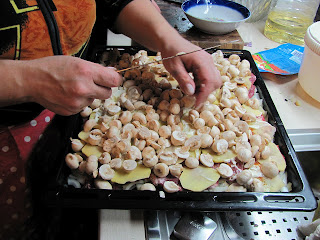
Oven baked beef the “French way”

Oven baked beef the “French way”
1. Thinly
slice beef, salt and put in covered bowl in refrigerator for several hours.
2. Slice
4 large onions and layer on large baking pan.
3. Layer
meat on top on the onions. Sprinkle with a package of spices for meat (not sure
what they were, but you could use anything that works for beef).
4. Peel
and thinly slice two potatoes and layer on top of the meat.
5. Layer
400 g. mushrooms on top—use very small mushrooms so they can be left whole, or
slice if needed.
6. Add
a layer of cheese and bake until done.
Olivie Salad
Chop finely cooked carrots and potatoes. Mix with chopped
hard boiled eggs, some kind of meat—usually ham or sausage, but we used
chicken--, chopped pickles, a can of peas, and mayonnaise and salt and pepper.
 Shuba Salad: (also called Fish under a Fur coat)

1. Boil
2 beets, 2 potatoes, 1 carrot; cool and peel.
2. Gut
and chop up one salted raw fish (herring)
3. Layer
to make salad—Grated potatoes, mayonnaise, fish, mayonnaise, grated carrots,
mayonnaise, grated beets, and top with layer of mayonnaise. Decorate with
mustard.

1. Finely
chop up 2 onions and ½ kg. mushrooms. Saute in butter.
2. Boil
2 skinless chicken breasts and cool and shred meat.
3. Grate
and peel 4-6 beets. Mix with 6 minced garlic cloves, a handful of finely
chopped black prunes, mayonnaise.
4. To
make the salad, put an overturned glass into the center of a large plate to
create the ring. Layer shredded chicken, mushrooms and onion mixture,
mayonnaise, the beet mixture.
5. Cover
the ring with 2 cups finely chopped walnuts and pomegranate seeds (one whole
pomegranate).
Subscribe to:
Posts (Atom)