Showing posts with label beverages. Show all posts

Sunday, September 9, 2012

Train Food Memories

This past week I did a rare thing for most Americans--took a train ride--and although the scenery was different (traversing along the Pacific Coast from Los Angeles to San Diego) it brought back many memories of so many train trips in Ukraine, so I thought I'd share a bit about Ukrainian train food.

Last summer, Sarah and I embarked on trains that literally took us around Ukraine--from Kyiv to Donetsk to Simferopol to Odessa to L'viv and back to Kyiv.   It was holiday season for many and I was struck by two ways in which local residents living near train stations made additional income by supplying food to those hungry travelers.
At several stops,  people waited for trains to pull in and sold food up into the doors and windows of the train:  smoked fish,  corn on the cob, and more.   Anxious travelers stocked up for the overnight trip. (sorry for the blurriness of some of these photos,  taken on the fly through a train window)
Still other entreprenuers appeared with buckets and baskets of berries, peaches, plums, cherries and more, to be purchased as fresh as can be, gently carried home, back to the city, for canning and preserving.  At one station in the Carpathians, travelers passed through a friendly gauntlet of women with all sorts of fresh (and as we can attest, delicious) things for sale.  It reinforced for me the ongoing importance for Ukrainians of a direct connection between consumers and producers.  You want to be able to look a vender in the eye and talk about the food.
We were no exception. Before we started off on any Pickle Project ride,  we stocked up with food to sustain us along the way:  pickles,  salty string cheese, dried fruit and leposhka, a round bread like naan, baked on an oven.  If it was summer, berries, cherries and plums;  in winter,  dried fruit.

And of course, there's one drink that epitomizes Ukrainian train travel to me.  It's that hot morning tea,  delivered briskly by the train attendant to your compartment in the morning as you approach your destination in its old fashioned yet lovely glass with a metal holder that clinks a bit as the train lumbers and rattles along and you watch the countryside pass by.  If you've been a Ukrainian train traveler, what food memories can you share?

Sunday, August 21, 2011

Tea on a Summer Afternoon

We recently had the good fortune of spending the afternoon with my friend Nataliya’s family in Yanif. Located northwest of L’viv, Yanif (also called Ivano Frankove) sits at the edge of the Roztochya Forest Preserve and on the shores of a sizable lake historically known for the salty, smoked fish produced there.
From the marshrutka stop, we made our way through the village, along the dusty roads and winding alleys, past raggedy dogs and fenced yards filled with chicken coops, roses and potatoes to Nataliya’s grandparents house. Cheerful and generous, Pavlina and Volodymyr Litynski are are in their 70s and maintain an energetic and lively household.

They live in a simple house with a small but bountiful kitchen garden, a little greenhouse made of windows for growing tomatoes and a few fruit trees. It is there that I have learned much about Ukrainian food traditions. In addition to being industrious vegetable gardeners and orchard keepers, three generations of this family, including my friend Nataliya, her mother, Halya, and her grandfather, Volodymyr, are all foresters and are knowledgeable experts on native Ukrainian berries, mushrooms and wild herbs.
It was one of those clear, blue summer afternoons and we found Volodymyr sitting in the grass, sorting just-picked red currants. After surveying the various stages of vegetables and fruits in the garden, as we always do when I visit, Volodymyr carried the kitchen table out into the dappled shade of the yard, much the way my own grandparents would on a summer day.
Under the trees, we nibbled seernik, a light Ukrainian cheesecake, with fresh raspberries and sipped a refreshing herbal tea that Pavlina made. The tea was a local mélange of wild raspberry leaves, wild strawberry leaves, nettles, mint and the delicate fruits of basswood. (For the forestry geeks out there, they are technically nutlets with a thin leafy bract. We often see these marketed for tea in big Ukrainian city markets as well.) All of these were collected around Pavlina and Volodymyr’s garden and, then, hung and dried in the "shadow" of the trees. They store this mixture in a canister in their cool, dry pantry.
Despite the heat, we drank our tea hot and it provided that strange, cooling effect that warm and spicy foods produce. (Actually, I have always wondered about the physiological effects that spicy and hot foods precipitate. According to this 1999 Scientific American article, it has to do with the skin’s pain receptors, which can be stimulated by actual heat or by chemicals such as capsaicin, that simulate heat, to trigger a response from the nervous system.)
As we chatted and sipped, various neighbors passed through the yard, calling out greetings as they strolled by. Some carried borrowed garden tools, others bags of food or children. A few friends and cousins stopped to join us for a cup of tea, conversation and an idle moment during a busy season.


Special thanks to Pavlina and Volodymyr Litynski and Halya, Serhy and Nataliya Stryamets, as always, for their warm hospitality.

Saturday, May 14, 2011

The Milk Truck

While I was in Kyiv this spring,  Olga Trusova (who spent her childhood in Ukraine but now lives in California) and I had a conversation about not just sustainable food in terms of growing, but also in terms of how food gets to the final consumer--and how that's changing.   She then sent me these great photos she took of a milk truck last summer in Odessa.  The truck would come to your neighborhood and residents would line up,  with enameled tin containers in hand,  to fill up with milk.   As we talked, it reminded me of the milkmen of my own childhood, and the milk box on the back porch, which we filled with glass bottles to be returned and refilled and the early morning clank as the milkman replaced empty bottles with full ones.
Compare this milk truck with the way most of us buy milk here:  the milk goes from the farm to a bottling plant and then from a bottling plant to the grocery store.  We drive from our houses to the grocery store,  drive home,  drink the milk and then recycle the plastic container it came in.   That's alot of steps--and alot of fossil fuel,  to put milk on our cereal.   But of course, a milk truck isn't always convenient and it's  regular appearance presents challenges for many,  given the demands of work and family. So we make compromises.
I was struck however,  by the change that's implicit in these images.  Look closely--there's not a single young person lined up to buy milk this way and it seems milk trucks in Ukraine may be headed the way of the milk box on my family's back porch, replaced by plastic jugs in plastic bags. 

Sunday, April 24, 2011

A Sign of Spring


Today's guest post is by Sarah Whelan, a returned Peace Corps Volunteer to Ukraine.  Sarah and another PCV have founded Eastword,  an oral history project devoted to collecting and sharing of oral histories in the former Soviet States.  You can read more about their work--and hear first-hand accounts here. 

Gray. It’s the only word that comes to mind when I recall my first winter in Ukraine. I had arrived in October, to a glimpse of fall color that drifted away, yielding to gray and white woolen blankets of sky set above bare branches rooted in frost and frozen ground. The world seemed muffled, as silent people, bundled like nesting dolls walked from store to home, pressed cold hands against warm mouths while waiting for the marshrutka. Dogs wandered the street desperate for scraps and made the acres of dachas that stood behind my apartment building unsafe by their hunger.

“Is this it?” I wondered. “Is Ukraine this silent, cold, gray place? Growling dogs around each bend?” Survival, I concluded, would require preparation. I would be cold, silent, vigilant. I would be tough, silent, totally self-reliant. I would stand against this place solid as a statue, and as soon as I shaped my new, hardened countenance—There was Spring, bursting forth like a new world.

An entirely different country began to bloom, budding with new curiosities.
Once silent neighbors crowded the streets, planting flowers, cleaning away winter’s debris. They flooded into the dacha gardens, hands working furiously in the dark soil to plant the seeds of summer.

Then—a legend arrived: a large yellow barrel rolled out in to the park with one of the only words in Russian or Ukrainian I had known before arriving, Kvass. This was the drink mentioned by Tolstoy in War in Peace. The drink that the French turned down, saying “This is what you serve to the peasants.” The slightly alcoholic drink made from fermented bread. There it stood in its yellow barrel like a cylinder of sunshine people young and old gathered around it, and I felt like I was on the verge of discovery. I took my first sip, and… was it cola, beer, sweet or yeasty, sour? It was all of the above and my tongue didn’t know what to make of it.

Several days later a teacher at school asked me if I tried the drink. Yes, I confirmed.

“Did you like it?”
I shrugged. “It was okay.”
“Where did you have it?”
“The park.”
“Oh well, that’s not the right place to have it. You come over. I make good kvass.”
In her small kitchen the following day, she took great care and pride in explaining how to choose the right dark rye bread, how to create the croutons (or suhari), the right amount of sugar and the all important fermentation starter, zakvaska. Her eyes sparkled as she placed the jar delicately in the refrigerator, as if delivering a newborn to its mother for the first time. “And then you wait,” she said smiling. “It must turn a nice color.” She turned to face me, this time with a finished jar. “Like this.” Twinkle. Twinkle.
I sipped…. Sour, sweet, cola, beer? Again the confusion of flavors.  A doubtful and weak, “Mmm,” emerged from my closed lips.
“It’s good, yes?” she twinkled on.
“Very,” I said, not knowing if I was lying or not. After all, how would I have any idea of what was good kvass and what was bad? I took another sip. Still hadn’t a clue.
“My husband,” she shared, “does not like it very sweet.”
I nodded unaware of how sweet it could be. As the season developed, warming through to blooming flowers, the kvass developed as well. As the gardens began to produce, the kvass shared the bounty--mint and berry lifted on the soft bubbles of carbonation, delivering the harvest, a growing spectrum of flavor as spring turned to Summer…. And then, as magically as it appeared, it disappeared. As a new academic year began and autumn began to threaten cold, the bright yellow barrel retreated. Gone.
Years later I can say that I miss kvass. Not its slightly sour, sometimes sweet, mildly alcoholic variations, but I miss that big yellow barrel in the park. I miss this Norman Rockwell scene of neighbors gathered around in the ultimate declaration of spring. Winter is over and young and old alike would raise a plastic cup in celebration, the signal to leave the cold behind.

Thursday, April 14, 2011

From the Wedding Tree: Kalina Berries


Thanks to Peace Corps Volunteer Barb Trecker for soliciting another contribution to the Pickle Project.  Kalina berries are a vital part of Ukrainian traditions, and here's a short article and recipe by text by Larisa Malykh of Kiliya, Ukraine, above photo by Viacheslav Malykh, and translation by Barbara Trecker.
 
From ancient times, viburnum (kalina) was a favorite tree in Ukraine, loved by all people for the beauty she gives. In spring, viburnum blossoms are little snow-white umbrellas that look like the headdress of a fiancée. In autumn, viburnum makes the eye happy with its bushes and blood-red berries, which hang on through the frosts. Kalina was the traditional symbol of love and beauty, so wedding tables were decorated with these branches – and  thus the name “wedding tree.” But viburnum was not only admired for its beautiful attributes. This is also a remarkable medicinal plant! The viburnum plant contains ascorbic acid, tannins and glycosides, and for health maintenance, has enough vitamins to exceed the exotic lemon! In antiquity, the bark of viburnum was used as a styptic agent, and as a sedative for cramps. 

Kalina berries are very delicious, especially after frosts. From recipes dating back to olden times, remarkable pies can be prepared, as well as cheesecakes, jams, fruit jellies, and pastries. All these sweets were easily accessible, and favorite for any family.  

Viburnum also has applications in cosmetics and dermatology: the extract of viburnum flowers is a treatment for allergic skin reactions, and viburnum juice is a treatment for blemishes.

Babushka's  Recipe 
Try it – it’s delicious! 
To prepare a delicious and nourishing drink, the best thing to do is collect viburnum berries in winter, and grab them right after a frost. Pour boiling water over the frozen berries, and immediately pour the water back off. Then mash the berries, and again inundate them with boiling water. This will be ready to drink in 10-15 minutes. For better taste, add a globule of honey and a splash of lemon. 
  
Second photo:  Kalina berries in a house at Pyrohiv,  the outdoor museum;  bottom:  dried kalina berries for sale at a market,  April, 2011

Wednesday, June 30, 2010

Historic Food Images 4: From L'viv


My last trip to L'viv was also my last chance, this visit, to look for historic photos related to food.  The craft market in L'viv, near the opera house, yielded some fascinating images.   Above, some proud (and well-dressed) workers at a flour mill.  Below, a stylish sip of something.


I can't quite tell what's going on in the image below.  A bride?  The slat basket over the one man's shoulder is a really familiar, well-used form even today.  Just last week I saw many people coming in on the trains to Kyiv with this over their shoulder, filled with berries or cherries and covered with a cloth.   Anyone able to tell us what's happening here or where the image might be from?


And just because it's a beautiful image, this color postcard of apples.  Enjoy!

Tuesday, March 23, 2010

The Refreshment of Spring: Birch Juice


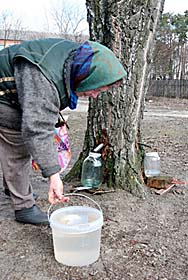
Spring has sprung and it is time for birch juice! Birch sap flows in the early spring when the nights are cold but the days are warm, usually March and April in Ukraine. Birch juice tastes mostly like water with barely perceptible sweet, woody notes. As a food source, it is rich in vitamin C, sodium, potassium, manganese and calcium. As both Ukrainian foresters and grannies will attest, birch juice has medicinal properties and is a salubrious beverage. It is touted as an antioxidant that particularly supports the liver and kidneys. Unlike North American maple sap, in Ukraine, birch sap is typically drunk in its unadulterated form, rather than boiled into a thick, sweet syrup. (I have never seen birch syrup in Ukraine but, apparently, it is made. However, it is rather resource and time intensive. According to University of New Hampshire Cooperative Extension, the ratio of raw birch sap to syrup is 100 to 1. By comparison, 40 liters of raw maple sap are required for 1 liter of maple syrup. Despite this, birch syrup is allegedly an emerging cottage industry in Alaska.)

Many rural Ukrainian households collect and preserve birch juice for personal consumption. However, in Ukraine, the State Forestry Enterprises tend to be the largest collectors and have developed commercial operations. Several species of birch (Betula) may be tapped for juice. This involves driving a hole into the truck of the tree. As the temperature rises, the clear liquid sap flows from the hole and into waiting buckets. After collection, the juice is usually strained and enjoyed. However, birch sap is highly perishable and must be pasteurized and preserved almost immediately. Some folks prefer a little sugar or honey in their birch juice while others like it pure. I have also heard of birch wine and birch-vodka cocktails, although I have not yet had the pleasure!

If you have stories or photos related to tapping birch, preserving sap, the therapeutic wonders of birch juice or serving suggestions, please share. We would love to hear from you!

For information about tapping birch trees and making syrup, in English, see the University of New Hampshire Cooperative Extension’s site.