It's not quite a food product, but it is a use of a forest (more or less) product, so I wanted to take note of Willow Sunday--what I grew up calling Palm Sunday. Palms aren't exactly common in Ukraine, so somewhere along the way, they were replaced by willow branches--and more specifically, by bunches of pussy willows, sold outside of churches.
Each vendor has wrapped up bunches of pussy willows in their own way. Some are fully open, others are combined with bits of greenery, and still others are just twigs. Some are tied with ribbon, others just gathered together. Purchasers spend a great deal of time in conversation contemplating the purchase of this simple, yet beautiful bouquet. Easter was earlier this year than last, so I wondered if the willows would be ready--somehow they were, and when I was in the mountains last week, after Willow Sunday, I noticed that willows were already leafing out.
What do you do with your bunch of willows? Take them to church to have them blessed, and then, stroll around the city with your family. And in this post, just a few of the vendors and Kyiv's citizens celebrating the day between St. Michael's and St. Sophia.
It always seems a bit disconnected when you visit an antique show or flea market--those objects and photos are untethered, let loose from the people and places that gave them meaning. However, it's always worth a look to see what you can discover and what you might learn. Last weekend I went to the antiques market here in Kyiv, and amidst the great textiles, the guns and swords, the icons, and the paintings of Lenin, I found some piles of photographs. Searching through, I found some related to food and food production and began my own small collection. I really don't know anything about these photos, other than the fact that several seem to relate directly to collective farming, and I hope some of the Pickle Project readers will both share what they know, if anything, about the content of these photos and share your own photos of foodways from Ukraine or the diaspora--from any time period--with us.
Understanding the historic context of Ukrainian foodways, in particular throughout the rapid, complicated change of the 20th century, is critical to our understanding of foodways today. So tell us more!
Just a few quick observations as I’ve returned to Ukraine for the next four months. As I settle in, the Pickle Project encourages me to look more closely at the world I see every day. In grocery stores in Kyiv, you can buy fruits and vegetables from around the world, at any time of year—the kind of grocery shopping that many of us, no matter where we live, have perhaps become too accustomed to. Avocados, yes; eggplants, yes; strawberries; yes.
But outside Kyiv’s metro stops you see what eating locally really means in this climate at this time of year. At every Metro station, there are kiosks selling sodas and beer, the to me unusual purveyors of lingerie and stockings, and almost everywhere, women who come in from villages every day, with the ubiquitous plaid plastic market bags, to sell what they grow or make.
It’s just becoming spring, so what I see right now are edibles that have over-wintered: nuts and pumpkin seeds, onions, potatoes, apples, the red kalyna berries (a symbol of Ukraine), mushrooms, cut-up orange squash, and these very small red and yellow items that I think are a sort of pumpkin or squash. I was late for something so didn’t have time to stop and ask. Anyone want to make a guess for me? [A one day later note--these are flower bulbs!] I even bought a tiny handmade Easter basket that looks like it’s made from woven cornhusks.
It’s a way of eating that many of us have forgotten—and in the case of the vendors (almost always women) provides important financial support for their families. As for me, I look forward to seeing what spring and summer will bring.
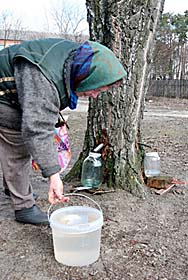
Spring has sprung and it is time for birch juice! Birch sap flows in the early spring when the nights are cold but the days are warm, usually March and April in Ukraine. Birch juice tastes mostly like water with barely perceptible sweet, woody notes. As a food source, it is rich in vitamin C, sodium, potassium, manganese and calcium. As both Ukrainian foresters and grannies will attest, birch juice has medicinal properties and is a salubrious beverage. It is touted as an antioxidant that particularly supports the liver and kidneys. Unlike North American maple sap, in Ukraine, birch sap is typically drunk in its unadulterated form, rather than boiled into a thick, sweet syrup. (I have never seen birch syrup in Ukraine but, apparently, it is made. However, it is rather resource and time intensive. According to University of New Hampshire Cooperative Extension, the ratio of raw birch sap to syrup is 100 to 1. By comparison, 40 liters of raw maple sap are required for 1 liter of maple syrup. Despite this, birch syrup is allegedly an emerging cottage industry in Alaska.)
Many rural Ukrainian households collect and preserve birch juice for personal consumption. However, in Ukraine, the State Forestry Enterprises tend to be the largest collectors and have developed commercial operations. Several species of birch (Betula) may be tapped for juice. This involves driving a hole into the truck of the tree. As the temperature rises, the clear liquid sap flows from the hole and into waiting buckets. After collection, the juice is usually strained and enjoyed. However, birch sap is highly perishable and must be pasteurized and preserved almost immediately. Some folks prefer a little sugar or honey in their birch juice while others like it pure. I have also heard of birch wine and birch-vodka cocktails, although I have not yet had the pleasure!
If you have stories or photos related to tapping birch, preserving sap, the therapeutic wonders of birch juice or serving suggestions, please share. We would love to hear from you!
For information about tapping birch trees and making syrup, in English, see the University of New Hampshire Cooperative Extension’s site.
Although Valentine’s Day is not widely celebrated in Ukraine, all of the chocolates being exchanged remind me of the Ukrainian penchant for giving chocolates. I learned about the practice of chocolate giving at the end of my first trip to Ukraine. As a colleague arrived to drive us to the airport, he presented me with an enormous box of chocolates. (It really was a huge box of chocolates! Perhaps, 18 inches long and 12 inches wide (40cm X 30cm). I had to hand-carry it because it would not fit in my suitcase..)
Now, after living in Ukraine, I have come to understand chocolate giving as a common ritual, sometimes charged with meaning and sometimes without expectation whatsoever. My friend, Katarynka, once told me that Ukrainians love chocolates but that they really love chocolates in boxes. This, she said, is because, during the Soviet era, boxes were fancifully decorated and typically came from abroad, which was considered more extravagant. Giving of any gifts, she explained, was and, arguably, still is a strategy for securing personal economic and political livelihood. Conversely, another friend, Natalia, who is a bit younger and grew up in a post-Socialist Ukraine, told me that she thinks it is “social” to bring good chocolates to friends or colleagues to enjoy with coffee. And, she added, they are tasty.
In her article on the culture of gift giving in contemporary St. Petersburg (And, by the way, the Pickle Project endeavors to fill the void of Ukrainian-specific food studies!) Jennifer Patico (2002) explores how the giving of small gifts, and chocolates, in particular, inform post-Socialist identities. She also further examines how these customs reflect and overlap with the social and transactional networking that was central to Soviet era life. Whereas, during the Soviet period, people drew on their connections to meet their material needs for goods and commodities, today, with a range of consumer goods available, urban Russians rely on money to achieve those ends. Now, Patico’s research suggests, gifts are used not as direct payments or bribes, but as “signs of attention” or spontaneous expressions of gratitude. They symbolize recognition that relationships are appreciated and in good standing, while reinforcing a kind of social commonality. Reflecting the variation in my friends’ responses to the chocolate question, Patico writes that gifts can be variously interpreted and that their meaning is often expressed by the choice of item selected. Boxes of chocolate (for women) and bottles of cognac (for men) are both neutral and traditional, reflecting the tastes of neither the giver nor the receiver. Nonetheless, chocolates in a decorative box are a good gift, she found, because a person would never buy a box of chocolates for themselves. Furthermore, they are frivolous, fleeting and delicious.
Regardless of the reason for the gift, Ukrainian chocolates come in a dizzying array of shapes, flavors and fillings. There are ones with poppy. And, coffee crème, almonds and crispy rice and marshmallow (delightfully called “hummingbird’s milk”) and cognac-soaked cherries and raspberry jelly. There are wafers, layered with hazelnut ganache. There are cones filled with champagne-flavored crème. My personal favorites involve the mingling of honey and almonds..
Chocolate confectionary is rather old industry in Ukraine, apparently dating back to the 18th century. According to Ukraine.com, as L’viv emerged as an important hub of the Austro-Hungarian Empire, it also became a center for confectionery. In combined celebration of this history and International Women's Day, the 3rd Annual Chocolate Festival will take place in L’viv March 6-8, 2010.
For thoughtful academic discussion of gift-giving in Russia, see Jennifer Patico’s 2002 article “Chocolate and Cognac: Gifts and the Recognition of Social Worlds in Post-Soviet
What makes a great Ukrainian pickle? It's complicated--and different for every family. Irina Leonenko was good enough to share her mother's quest for the perfect pickle. Here's her family story.
I asked my mom and dad, "I have a serious question for you! What does pickle mean to you?" My mom said it's the beginning of fall and winter times; it's a tradition in our family, all our grandmother had their own recipes for pickles, but my dad likes my mom's recipe best.
In fact there is a "pickle" story in our family. My dad loved his mother's pickles and for many years my mom tried to learn the recipe from her mother-in-law but they never turned out the way my dad liked. My mom tried everything: black currant leaves; garlic before boiling water and after boiling water; less salt, more salt; horse radish, and simply horse radish leaves; she even used to send me and my brother in early September to find cherry trees in the area and pick some leaves. We also had to always go to the market in fall to buy dried dill and dried horseradish leaves from an old babushka (for whom it was the main product to sell in September).
After many years, my mom spoke to somebody in her office and is sure she found the "secret ingredient" that was missing in her mother-in-law's recipe. Even today my mom still believes my grandmother (her mother-in-law) did that on purpose because she wanted her pickles taste better and she wanted to please her son (my dad).
My mom's pickles before turned out to be soft, but now they are crispy and have the right balance of salt and necessary herbs that pickles require. My mom never uses vinegar, not anyone in our family used vinegar for pickles. That's why we never buy Supermarket pickles, because they have a strong taste of vinegar (quick and cheap), just like Greeks would never eat canned olives, instead they first dry them in the sun and then marinate for a long time in good olive oil.
My dad had nothing to add to the pickle story, he simply can't live without them, especially in winter. By now, my mom by knows exactly how many 3 liter jars of pickles she has to have per winter for only my dad.
So, this is our family pickle story. I think Ukrainians never really think what pickles mean for us. We simply grow up with them. They are present even at the wedding tables and nobody ever thinks that there won't be any. Another thing, at any party, if there is Vodka there is definitely a Pickle.
And, Irina added, "My mom is a modern Ukrainian woman, but still doing pickles, so that's also good!" We want to hear your stories about traditional Ukrainian pickles and other foods in Ukraine or around the world. Send us pictures, stories or questions.
Photos: Gala Leonenko making pickles, fall, 2009. By Irina Leonenko